


If you’ve been hearing more and more about weight loss medications lately, chances are names like Ozempic, Wegovy, and Mounjaro keep coming up. At first glance, they can seem almost identical—weekly injections designed to help with blood sugar control and weight loss.
But here’s where things get interesting: Mounjaro isn’t just another option. In many ways, it represents a real step forward—and it actually works a bit differently from Ozempic.
Before we get into the details, let’s take a moment to understand what Mounjaro really is and how it works. That way, you’ll be able to see why it’s getting so much attention—and whether it might be relevant for you.
If you’ve noticed that losing weight isn’t as easy as it used to be—or that your body responds differently in your 40s or 50s—you’re not alone.
Disclaimer: This article is for informational purposes only and is not a substitute for medical advice. I’m not a healthcare professional, and this content is not intended to diagnose, treat, or replace guidance from your doctor. If you’re considering medications like Ozempic or Mounjaro, it’s always best to speak with a qualified healthcare provider who understands your personal situation.
Key Differences Between Mounjaro and Ozempic
Mounjaro and Ozempic each have their unique advantages. Mounjaro’s approach offers a dual-action mechanism, which may enhance weight loss and better control blood sugar levels compared to Ozempic. Understanding how these mechanisms differ can help you make informed choices for your health journey.
What Is Mounjaro—and How Does It Actually Work?
To understand why Mounjaro is creating so much buzz (and how it differs from Ozempic), it helps to start with the basics: what it is and how it works in your body.
Mounjaro is a prescription medication originally approved to treat type 2 diabetes, now also prescribed for weight management in several countries. Its active ingredient, tirzepatide, mimics not one but two hormones—GLP-1 AND GIP that help regulate blood sugar, appetite, and how your body uses energy.
How It Works:
- Helps your body release insulin more effectively while reducing excess sugar production
- Slows digestion, so you feel full longer after meals
- Naturally reduces appetite, making it easier to eat less—especially when combined with strength training and enough protein
- Delivered as a simple once-weekly injection, using a pre-filled pen
Mounjaro vs Ozempic: The Real Difference in How They Work
If you’ve wondered what really sets Mounjaro apart from Ozempic, the answer lies in how each medication works inside your body.
Most weight-loss medications like Ozempic and Wegovy work by mimicking GLP-1, a hormone that slows gastric emptying, signals fullness to the brain, and stimulates insulin release.
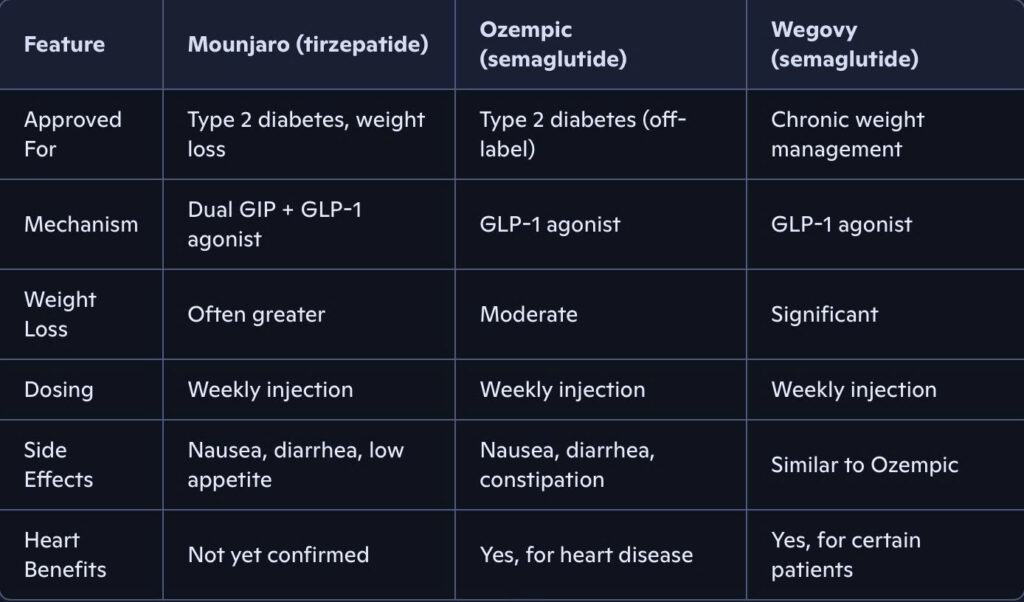
Mounjaro, however, activates both GLP-1 and GIP pathways. This dual action means it doesn’t just replicate what drugs like Ozempic do—it builds on it. Early research suggests it may lead to greater fat loss, improved insulin sensitivity, and in many cases, more significant weight loss overall.
That said, results can vary from person to person.
How Mounjaro Stacks Up Against Ozempic and Other Medications
If you’re trying to decide between these options, this quick comparison can help you see the differences at a glance:
What Users Are Saying About Mounjaro
Don’t just take our word for it—hear user experiences!
★★★★★ Rated 5 out of 5
“Mounjaro has truly changed my life! I’ve lost 30 pounds and my blood sugar levels are the best they’ve been in years!”

– Sarah T., 45
★★★★★ Rated 5 out of 5
“The results have been impressive, and I feel more energetic than ever. I’d recommend Mounjaro to anyone looking to regain their health.”
– John D., 52
★★★★★ Rated 5 out of 5
“I was skeptical at first, but Mounjaro’s effects have surpassed my expectations. It’s not just about weight loss; it’s about feeling good!”
– Emma L., 36

Why Mounjaro’s Dual Hormone Action Could Be a Game-Changer
So why does Mounjaro’s dual hormone approach make such a difference? Let’s break down how targeting two pathways could give it an edge over other medications like Ozempic.
Your body is incredibly complex, and metabolism is shaped by many different systems working together. That’s why Mounjaro stands out. Instead of acting on just one hormone pathway like other medications, it targets two—which may give it some extra advantages.
First, it can lead to greater weight loss. In large clinical studies comparing Mounjaro with Wegovy, people taking Mounjaro lost about 20% of their body weight on average, while those on Wegovy lost about 14%. That may not sound like a big gap, but if you weigh 200 pounds, it’s the difference between losing around 28 pounds versus 40 pounds—enough to matter for health and quality of life.
Second, it may help more people see results. Some individuals respond better to one hormone pathway than the other. Because Mounjaro works on both, it increases the chances of seeing results and could benefit people who haven’t seen strong results from single-pathway drugs.
Finally, it seems to support broader health improvements. Early research shows Mounjaro not only helps with blood sugar and weight, but also improves markers linked to heart and kidney health. There are even signs it could reduce liver fat and boost metabolism, though these findings are still being studied.
Mounjaro vs Ozempic: What It Could Mean for Your Weight and Health
If you’re weighing your options for diabetes or weight-loss medications, here’s what choosing Mounjaro over Ozempic could actually mean for you:
-
Effectiveness: because Mounjaro works on two hormone pathways instead of one, studies show it often leads to greater weight loss and better blood sugar control than medications like Ozempic or Wegovy.
-
A second chance: if you’ve tried a GLP-1 medication before and didn’t see the results you hoped for, Mounjaro may still work for you.
-
Cost vs. benefit: these medications can be expensive. But if Mounjaro delivers stronger and more sustainable results, it may offer better value over time.
Real Results
Clinical Insights Uncovered
Recent clinical studies show impressive results with Mounjaro. Users report significant weight loss along with improved metabolic health. Leading endocrinologists highlight its role in lowering cardiovascular risks, making it a valuable option for those looking to enhance their health beyond just weight management.
Mounjaro vs Ozempic: Side Effects You Should Know About
No medication is without side effects, so it’s important to know what to expect if you’re considering Mounjaro compared to Ozempic:
-
Nausea
-
Diarrhea
-
Decreased appetite
For most people, these effects tend to improve over time as the body adjusts. More serious side effects are less common but can occur, which is why it’s important to talk with your healthcare provider. They can help you decide if Mounjaro is a safe and suitable option for your health needs.
These side effects are similar to what people experience with other GLP-1 medications and are often dose-dependent.
My Personal Take on Using Mounjaro
Now that we’ve covered the facts, let’s shift gears and explore what this means on a human level.
For most of my life—like many active people—I’ve earned my health through movement: training, stretching, lifting, recovering. That effort gave me strength, confidence, and a sense of freedom. Recently, however, tools like Mounjaro seem to offer another path to health.
Of course, for those facing real health conditions, I absolutely encourage them to discuss this option with their doctor. At the same time, I’ve noticed others using it more like a shortcut to drop weight fast. So I find myself asking: is it a shortcut—or simply a different way to regain control?
Perhaps, it’s not about choosing one over the other. Health has multiple solutions, and what works for one person may not work for another. Managing it with medication doesn’t erase the value of earning it through movement. In fact, both paths are valid and respectable.
Whether Mounjaro is a time-saver, a tool, or a lifeline really depends on the individual. For some, it’s the breakthrough they’ve been waiting years for—and honestly, that’s a good thing. For others, it’s just one piece of a larger puzzle, alongside training, mindset, and nutrition. The real question becomes: does it help you live better?
We can’t outsource our health entirely. Yet, we also shouldn’t ignore the tools science gives us. The sweet spot is awareness—knowing when to push harder, when to rest, and when to accept help. For me, that means staying active, eating clean, sleeping deeply—and staying open to innovation that supports my goals.