
Let me be completely honest with you: I’m not typically an “app guy,” especially when it comes to working out. When I hit the gym, I usually want to complete my session without staring at a screen or wrestling with clunky menus. However, when I set out to write this best fitness apps review, I put my skepticism aside to test Fitbod, Caliber, Dr. Muscle, and Future Pro.
If you have ever searched the App Store for a solid workout tracker, you already know how overwhelming it can be. Some apps feel like an endless textbook, while others hide basic features behind aggressive paywalls. Fortunately, a few apps actually feel like having a smart coach right in your pocket.
To help you figure out which tool fits your routine, here is my honest breakdown of all four options. We will look at what works, what gets annoying, and where you should spend your hard-earned money.
The Quick Breakdown
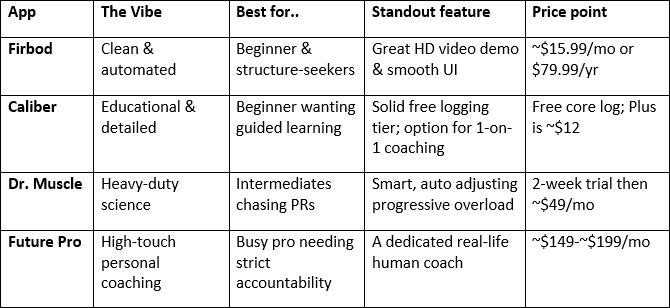
If you are in a rush, here is a quick look at how these platforms stack up side-by-side:
1. Fitbod: The "No-Brainer" Digital Coach
First, I was genuinely surprised by how much I enjoyed testing Fitbod. Right off the bat, the design is sleek, simple, and visually attractive. The User Interface (UI)—which is just a fancy term for how the app looks, feels, and navigates—is one of the cleanest I’ve used. In addition, setting up your profile takes just a couple of minutes. It asks about your goals, equipment, and experience level, and then boom—your workout split is ready to go.
What it’s like in the gym:
What impressed me most is how smoothly it guides you through a session. For instance, when you open up an exercise like barbell incline presses or deadlifts, it gives you exact targets for sets, reps, and weight.
Furthermore, every single movement comes with a high-quality video demonstration. Because of this feature, you won’t need a gym buddy to check your technique because the app itself acts as your coach. When you finish a set, you simply tap “Done & Next Exercise,” and it leads you straight to the next move. It even sends helpful notifications before it is time to train.
- The Verdict: If you want clear structure without the headache of planning your own routines, Fitbod is a fantastic choice. In addition it is perfect if you are just starting out and need clear structure without having to write your own lifting workout routine.
2. Caliber: Great Information, but a Bit Too Much "Fluff"
Next, Caliber takes a very different approach. It builds a complete program based on how long you want to train and how many days you can commit. It features over 600 exercises in its free library, and it syncs seamlessly with Apple Health, Strava, and Cronometer.
Where it shines—and where it drags:
If you are a complete beginner, Caliber acts like a massive fitness encyclopedia. It provides helpful articles explaining starting weights, strength metrics, and training concepts that answer almost any beginner question.
However, as an experienced lifter, I found all these extra lessons a bit overwhelming. Because there are so many readings baked in, I spent extra time staring at my phone screen instead of lifting. Additionally, while the basic tracker is accessible, advanced features like custom nutrition targets require upgrading to Caliber Plus or signing up for premium coaching.
- The Verdict: Caliber is ideal for beginners who want deep explanations and guided learning. However, experienced lifters may find the extra reading material creates unnecessary friction.
3. Dr. Muscle: No Flash, Just Pure Strength Science
In contrast to the others, Dr. Muscle strips away fancy graphics and cuts straight to performance. The dark-blue layout is very clear and easy to read at a quick glance. Therefore, you never have to pause your workout to figure out what set comes next.
The smart algorithm:
Where Dr. Muscle really wins is its internal logic. The app uses autoregulation to analyze your past performance. Then, it automatically adjusts your weights, reps, and rest timers for progressive overload without requiring manual calculations. On top of that, it is flexible. If a gym machine is busy, you can swap exercises on the fly without ruining your program split.
The onboarding is quick, and the app does not spam you with constant paywalls while you train. You receive a full 2-week trial, and after that, it steps back to a basic free log if you decide not to subscribe.
The main downside is the price tag. At ~$49/month, it is significantly pricier than Fitbod.
- The Verdict: Dr. Muscle is hands-down the best tool for intermediate lifters who have hit a plateau. However, that price tag is really only worth it if you train consistently.
4. Future Pro: Real Human Accountability
Finally, Future Pro belongs in a completely different category. Instead of relying on software algorithms, Future pairs you directly with an actual, real-life personal coach.
How it works:
Your trainer builds custom weekly workouts tailored specifically to your goals, equipment access, and daily schedule. They check in with you regularly via text and video messages, monitor your Apple Watch data, and adjust your routine whenever you travel.
The biggest benefit here is accountability. It is much harder to skip a session when a real person is checking your daily progress. However, the main drawback is the cost: at $149 to $199 per month, it is a serious financial commitment.
- The Verdict: If you struggle with consistency and want personal coaching without paying $100+ per hour at a commercial gym, Future Pro is an incredible option.
The Final Verdict: Which One Should You Download?
To wrap up this best fitness apps review, here is how to decide based on your personal goals:
- 🏆 Best All-Rounder: Fitbod — Clean, easy to use, great video guides, and automated workouts that just work.
- 🏆 Best for Complete Beginners: Caliber — Perfect if you need a lot of educational material and want your basic questions answered.
- 🏆 Best for Serious Hypertrophy & PRs: Dr. Muscle — Excellent autoregulated programming for lifters who want to push their limits.
- 🏆 Best for Maximum Accountability: Future Pro — A dedicated 1-on-1 human trainer right on your wrist.
What fitness app are you currently using, or which one of these four are you leaning toward trying? Let me know in the comments below!