If you’re searching for the truth behind fitness myths after 40, you’ve probably run into plenty of bad advice:
“Don’t lift heavy, you’ll hurt yourself.”
“Building muscle after 40 is basically impossible.”
“Just walk a bit… that’s all you need now.”
If you’ve heard these warnings enough times, you might have started believing them. But most fitness myths after 40 are completely outdated, overly cautious, and scientifically wrong.
Yes, your body changes as you age—recovery takes longer, hormones shift, and fat loss can feel slower. But none of that means you’re on a downward slide. It just means you need a smarter approach.
Let’s break down the most common fitness myths after 40—and look at what science actually says.
- Note:This article is part of the Debunking Fitness Myths: Facts vs Fiction For Better Health series — busting the beliefs that keep you stuck
Quick Summary (Read This First)
If you’re over 40:
✅ You can still build muscle
✅ You can still lose fat
✅ Your metabolism is not “broken”
✅ Strength training is more important than ever
✅ Mobility and recovery matter more than intensity
The goal isn’t to train like a 20-year-old.
The goal is to train smarter than you did at 20.
Fitness Myth No.1: “It’s Too Late to Build Muscle After 40”
This is one of the most damaging myths because it stops people before they even start.
The truth: you can absolutely build muscle after 40, 50, and beyond.
Yes, progress may be slower than in your twenties, but muscle growth is still very real — and it becomes even more important with age.
After around age 30, most people begin losing muscle mass naturally (around 3–8% per decade). This is called sarcopenia, and it accelerates with age if you don’t actively fight it.
And muscle loss doesn’t just affect appearance. It affects:
- strength
- metabolism
- bone health
- balance and stability
- injury and fall risk
Strength training is the best tool we have to slow or reverse this process.
What changes after 40?
Not your ability to build muscle — but your recovery needs.
- Recovery takes longer
- Protein needs increase slightly
- Hormonal shifts slow progress
What to do instead
Train consistently 2–4 times per week, eat enough protein, and allow proper recovery.
Fitness Myth No.2: “Cardio Is Enough — You Don’t Need to Lift Weights”
For decades, the default advice for adults over 40 was: walk more, maybe swim, keep the heart rate up. Strength training was seen as optional, or even risky.
Science has flipped this completely.
While cardiovascular exercise is essential for heart health and longevity, resistance training offers a different and equally important set of benefits:
- Preserves and builds muscle mass
- Increases bone density (critical for preventing osteoporosis)
- Improves insulin sensitivity
- Boosts resting metabolic rate
- Reduces the risk of injury in daily life
A major study published in JAMA Internal Medicine found that muscle-strengthening activities were associated with a 23% lower risk of all-cause mortality — independent of cardio. The two types of training work best together, not as alternatives.
Fitness Myth No.3: “Your Metabolism Slows Dramatically After 40”
This one has a kernel of truth — which is exactly what makes it so misleading.
Yes, metabolic rate does decline with age. But the scale of that decline is wildly exaggerated in popular culture, and — crucially — the cause is largely within your control.
A major study published in Science in 2021, involving over 6,400 people across 29 countries, found that total energy expenditure remains remarkably stable between the ages of 20 and 60. The dramatic metabolic slowdown most people expect simply doesn’t happen in that window. After 60, there is a more meaningful decline — but even then, it’s more gradual than commonly assumed.
So where does the “slow metabolism after 40” belief come from? Primarily from muscle loss — one of the most persistent fitness myths after 40.
Muscle tissue is metabolically expensive — it burns calories just by existing. As adults progressively lose muscle mass through inactivity (sarcopenia), their resting metabolic rate drops. This is not an inevitable consequence of aging — it’s a consequence of becoming less active and losing muscle.
Additional contributors to the perceived metabolic slowdown:
- Reduced NEAT (Non-Exercise Activity Thermogenesis): Older adults tend to move less throughout the day — fewer steps, less fidgeting, less incidental activity — which meaningfully reduces total daily calorie burn.
- Hormonal shifts: Declining estrogen and testosterone affect body composition and fat distribution, but their direct impact on metabolic rate is more modest than commonly believed.
- Diet quality drift: Eating patterns from your 20s and 30s carried into your 40s, while activity levels decline.
The fix: Resistance training to preserve muscle mass is the single most effective way to protect your metabolic rate as you age. Staying generally active throughout the day — beyond formal exercise — matters more than most people realize.
Your metabolism is not your enemy after 40. Inactivity is.
Fitness Myth No.4: “Heavy Lifting Is Dangerous After 40”
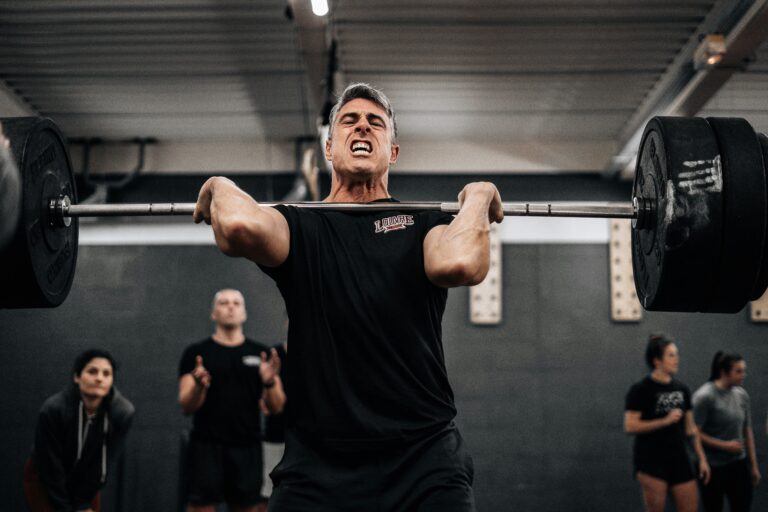
This myth keeps a lot of adults stuck doing light resistance work that simply isn’t enough stimulus to produce meaningful results — all out of fear of injury.
Let’s be clear about what the evidence actually shows: resistance training, including heavy compound lifting, is not only safe for adults over 40 — it’s one of the most protective things you can do for your long-term health.
Studies consistently show that strength training reduces injury risk in daily life, improves joint stability, strengthens connective tissue, and dramatically lowers the risk of falls and fractures. The risks of not lifting — progressive muscle loss, bone density decline, metabolic deterioration — are far greater than the risks of lifting intelligently.
What does change after 40 is not whether you should lift heavy, but how you approach it:
- Warm up more thoroughly. Connective tissue takes longer to reach optimal temperature and pliability. 10–15 minutes of progressive warm-up before heavy sets is not optional.
- Progress more gradually. Your tendons and ligaments adapt more slowly than your muscles. Add load conservatively and let your connective tissue catch up.
- Prioritize technique over ego. Breakdown in form — not heavy weights per se — is where most lifting injuries originate.
- Manage fatigue carefully. Lifting heavy when already fatigued significantly raises injury risk. Schedule demanding sessions when you’re fresh.
- Respect pain signals. There is a difference between the discomfort of genuine effort and sharp or joint-specific pain. The latter is a signal to stop and investigate.
The research on bone density alone makes a compelling case: heavy resistance training is one of the only evidence-backed interventions for building and maintaining bone density in adults over 40, directly countering the osteoporosis risk that increases with age. It’s one of the most persistent fitness myths after 40 that heavy lifting is dangerous — when in reality, lifting smart and progressively is what keeps you strong, stable, and protected.
Lift heavy. Lift smart. Don’t let this myth keep you in the light weights section indefinitely.
Fitness Myth No.5: “High-Intensity Exercise Is Too Risky After 40”
This myth has some truth buried inside it — but it’s been wildly overblown.
Yes, your injury risk profile changes with age. Connective tissue (tendons and ligaments) becomes less elastic, and recovery from high-intensity efforts takes longer. These are real considerations.
But the solution is smart programming, not permanent moderation.
High-intensity interval training (HIIT) has been studied extensively in middle-aged and older adults, and the results are impressive. A 2017 study from the Mayo Clinic found that HIIT actually reversed some cellular markers of aging in muscle tissue — more effectively than moderate-intensity cardio or resistance training alone. This makes it clear that one of the most persistent fitness myths after 40 — that high-intensity exercise is too risky — simply doesn’t hold up when training is approached intelligently.
Again, the key adjustments for doing high-intensity work safely after 40:
- Warm up properly. Spend 10–15 minutes genuinely preparing your joints and muscles — not just a few arm circles.
- Prioritize form over speed or load. Technique breakdown is where injuries happen.
- Space out hard sessions. 2 high-intensity sessions per week is plenty. More is not better.
- Listen to joint pain vs. muscle fatigue. Muscle soreness is normal. Sharp joint pain is a signal to stop.
Fitness Myth No.6: “Soreness Means a Good Workout — No Pain, No Gain”
Delayed onset muscle soreness (DOMS) after a tough workout is normal and even expected, especially when you try something new or increase intensity. But using soreness as your main measure of workout quality is a mistake — and one that becomes more costly after 40.
After 40, chasing extreme soreness:
- Extends recovery time unnecessarily
- Increases injury risk from training while still fatigued
- Can become a barrier to consistency if every session leaves you wrecked for days
A well-designed program for someone over 40 is built around progressive overload — consistently adding small amounts of challenge over time — not random intensity spikes that leave you unable to walk down stairs.
Soreness means your muscles were challenged. No soreness doesn’t mean your workout “didn’t count.” Consistency beats heroism every time.
Fitness Myth No.7: “Flexibility and Mobility Don’t Matter Until You’re Much Older”
Many people in their 40s only think about flexibility when something hurts. By then, they’ve already lost years of potential range of motion — and started developing movement compensations that can lead to injury.
Mobility work (dynamic stretching, joint mobility drills) and flexibility training (static stretching, yoga) become more important with age, not less.
One of the over is that looked fitness myths after 40 mobility doesn’t matter — when in reality, it’s a cornerstone of staying pain‑free and moving well.
Here’s why:
- Joints lose synovial fluid and cartilage elasticity over time
- Muscles naturally become less pliable
- Poor mobility in one area forces other areas to compensate, creating chronic pain patterns
Spending even 10–15 minutes a day on targeted mobility work pays dividends in how you feel, how you move, and how injury-resistant you become.
What the Science Actually Recommends for Fitness After 40
Based on the current evidence, here’s what a solid fitness approach looks like for adults in their 40s and beyond:
|
Strength training |
2–4 sessions per week, all major muscle groups |
|
Cardiovascular exercise |
150+ minutes of moderate intensity per week (or 75 min vigorous) |
|
High-intensity work |
1–2 sessions per week, well-spaced |
|
Mobility/flexibility |
Daily or near-daily, even if brief |
|
Protein intake |
1.6–2.2g per kg bodyweight |
|
Sleep & recovery |
7–9 hours; treat it as training |
A Personal Note from the Other Side of 40
Here I am right in this demographic—over 40—and I can tell you firsthand: the science is spot on.
My joints feel a little stiffer, my flexibility takes a bit more effort, and the days of jumping straight under a barbell without warming up are long gone. Now, before starting a heavy chest or leg day, I need a few minutes to get moving. A quick walk on the treadmill and some dynamic movement, and I’m good to go.
Cardio has become a staple at the end of almost every session. I’ll be honest: I still hate it. But I know I need to train my heart, and tossing in some bike HIIT intervals from time to time keeps it engaging.
Long story short, my training has definitely shifted in my 40s. But I actually love it—I embrace it. It’s an opportunity to adapt and learn my body all over again. I still love going hard and lifting heavy, but because the machinery moves a bit slower and demands more recovery, my goal is to protect and preserve it for the long haul.
It feels like the real race for longevity has just begun—and I’m all in.
The Real Takeaway
The biggest threat to your fitness after 40 isn’t age — it’s inaction driven by bad information.
Your body is remarkably adaptable at any age. The rules change a little: recovery matters more, consistency matters more, and smart programming matters more. But the fundamentals of getting stronger, leaner, and fitter remain the same.
Stop waiting for the “right age” to start. The science says the right age was yesterday — and today will do just fine.
- Enjoyed this article? It’s part of a series on fitness and nutrition myths. Head back to the Debunking Fitness Myths: Facts vs. Fiction for Better Health to explore the full collection, or dive into Nutrition Myths After 40: what the science actually supports.