
If your knees complain on the treadmill or your back aches after a run, I get it—you’re definitely not alone.
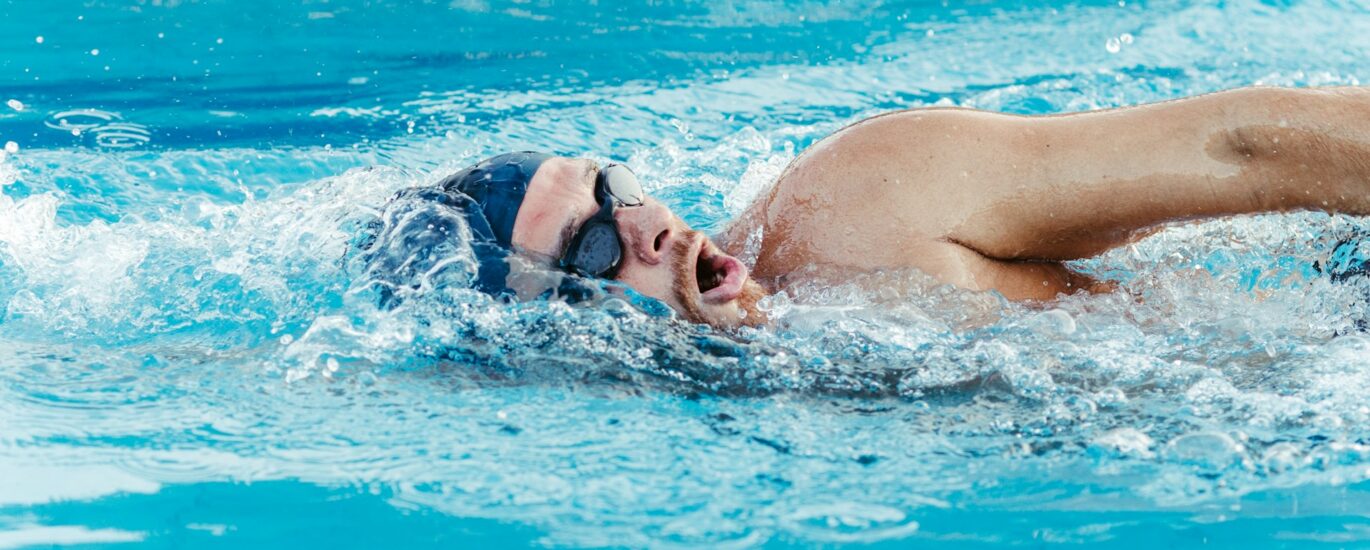
Swimming for longevity is really the sweet spot once we hit our late 30s, 40s, and 50s and our fitness goals start to shift. High-impact cardio that leaves your body feeling beat up just doesn’t make sense anymore. We want a great workout that protects our joints, burns solid calories, improves metabolic health, and keeps our heart strong.
That’s where the pool comes in.
Swimming for longevity gives you high-level cardiovascular conditioning with zero joint pounding. Whether you’re looking to swap out high-impact running or just want a great active recovery session between lifting days, here is why swimming is the ultimate lifelong fitness habit.
Swimming for Longevity: True Joint Protection Without Compression
When you run or jump, your joints absorb three to five times your total body weight with every impact. Over decades, this repetitive stress can lead to chronic inflammation, cartilage degradation, and joint stiffness.
In the water, buoyancy neutralizes gravity. Suspended in water, your body experiences up to a 90% reduction in apparent body weight.
This lets your shoulders, spine, hips, and knees move through a full, fluid range of motion without taking a beating. Pairing pool days with a dedicated routine for Mobility & Flexibility After 40 is one of the best strategies to keep your joints healthy for decades. It even stimulates synovial fluid production—your body’s built-in joint lubricant.
Total-Body Calorie & Metabolic Efficiency
Most traditional cardio relies almost entirely on your legs. If you think about running, cycling, or the stair-master, your lower body does nearly all the heavy lifting while your upper body is basically along for the ride.
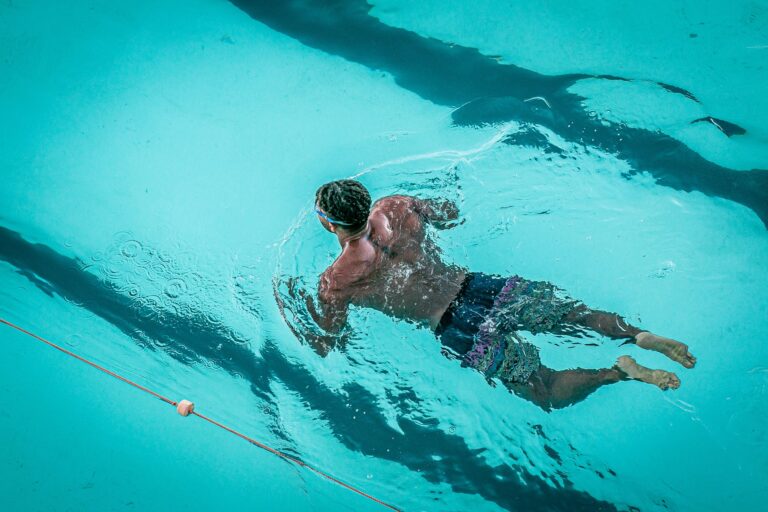
Swimming is totally different because it asks practically every major muscle group to show up at the exact same time:
- Upper Body: Your lats, shoulders, chest, and triceps power your stroke through every single lap.
- Core: Your abs, obliques, and lower back stay engaged to keep you balanced and horizontal in the water.
- Lower Body: Meanwhile, your glutes, quads, and calves generate steady, continuous propulsion with every kick.
Because water is roughly 800 times denser than air, every single stroke meets constant, uniform resistance. As highlighted by Harvard Health’s cardiac experts, moving through water provides far greater resistance than air, turning a short 30-minute swim into a high-yield metabolic workout.
Vascular Health & Reduced Cardiac Stress
Furthermore, taking care of your heart isn’t just about pushing your pulse to the absolute max—it’s really about improving blood vessel elasticity, lowering your resting blood pressure, and improving your VO2 max to lower chronic disease risk. Adding low-impact cardio to your week is just one of several essential Heart Health strategies to protect your cardiovascular system long-term.
Interestingly, swimming gives you a unique physical advantage over upright exercise. Because you’re moving horizontally, your heart doesn’t have to fight gravity to pump blood back up from your legs and feet. This improved blood flow allows your heart to pump more blood per beat with noticeably less effort.
Additionally, the controlled breathing patterns you use in the pool act as a built-in breathwork session. This naturally expands your lung capacity, calms your nervous system, and helps bring down baseline stress levels after a long day.
Time Efficiency: A Complete 20-Minute Pool Template
Best of all, you don’t need to spend an hour grinding out endless laps to see real results. Meeting your weekly aerobic activity goals through short, structured intervals gives you maximum benefits in minimal time.
Here is a straightforward, joint-friendly 20-minute pool template:
- Warm-Up (5 Minutes): Easy, relaxed lap swimming or water walking to loosen up shoulders and hips.
- Main Set (10 Minutes):
- 8 x 25-meter/yard lengths at a moderate, steady pace.
- Rest 20 to 30 seconds at the wall after each length.
- Focus on long, smooth strokes rather than speed.
- Active Recovery / Core (3 Minutes): Grab a kickboard or pull buoy and complete 4 easy lengths targeting just your kick or pull.
- Cool-Down (2 Minutes): Easy backstroke or leisurely side-stroke to lower your heart rate.
Essential Gear to Get Started
You don’t need much to build an effective pool habit, but having the right essentials makes every session more comfortable and efficient:
- Anti-Fog Swim Goggles: Clear vision prevents neck strain and eye irritation. Look for models with soft silicone gaskets and UV protection for outdoor pools.
- Training Pull Buoy: Placed between your thighs, a foam pull buoy elevates your hips automatically, letting you focus on upper-body conditioning without worrying about heavy legs sinking.
- Ergonomic Kickboard: Great for isolating lower-body strength and performing low-stress active recovery sets.
- Waterproof Bone-Conduction Headphones: Listening to your favorite music or podcast makes lap swimming fly by.
The Bottom Line
Ultimately, staying fit after 35 isn’t about beating your body into submission—it’s about working smarter so you stay strong, mobile, and energized for decades to come. Adding swimming for longevity to your routine just once or twice a week gives you that perfect sweet spot of heart health, calorie burning, and joint relief.
So grab a comfortable pair of goggles, hop into the slow lane, and let the water do the heavy lifting!